
Key Notes
- itch.io says it removed a couple of terabytes of low-quality AI content and gave no count or category breakdown for the affected projects.
- The No AI search filter matches creators who explicitly declare that their projects contain no generative AI.
- Tabletop game, book, comic and soundtrack creators must now complete the AI disclosure when they create or edit a listing.
itch.io says it deleted a couple of terabytes of low-quality AI-generated content and expanded its search filters so players can find projects whose creators say they used no generative AI. The independent storefront also made disclosure mandatory when creators publish or edit pages in four more categories, including tabletop games.
The November 3 removal announcement gave the size of the cleanup in storage, without a project count or a breakdown of games, assets and other uploads. itch.io separately reminded creators that its rules against mass-generated submissions have been in place for more than two years. itch.io’s reminder
Just deleted a couple terabytes of ai slop 😌
— itch.io (@itchio) November 3, 2026
What the No AI Search Filter Shows
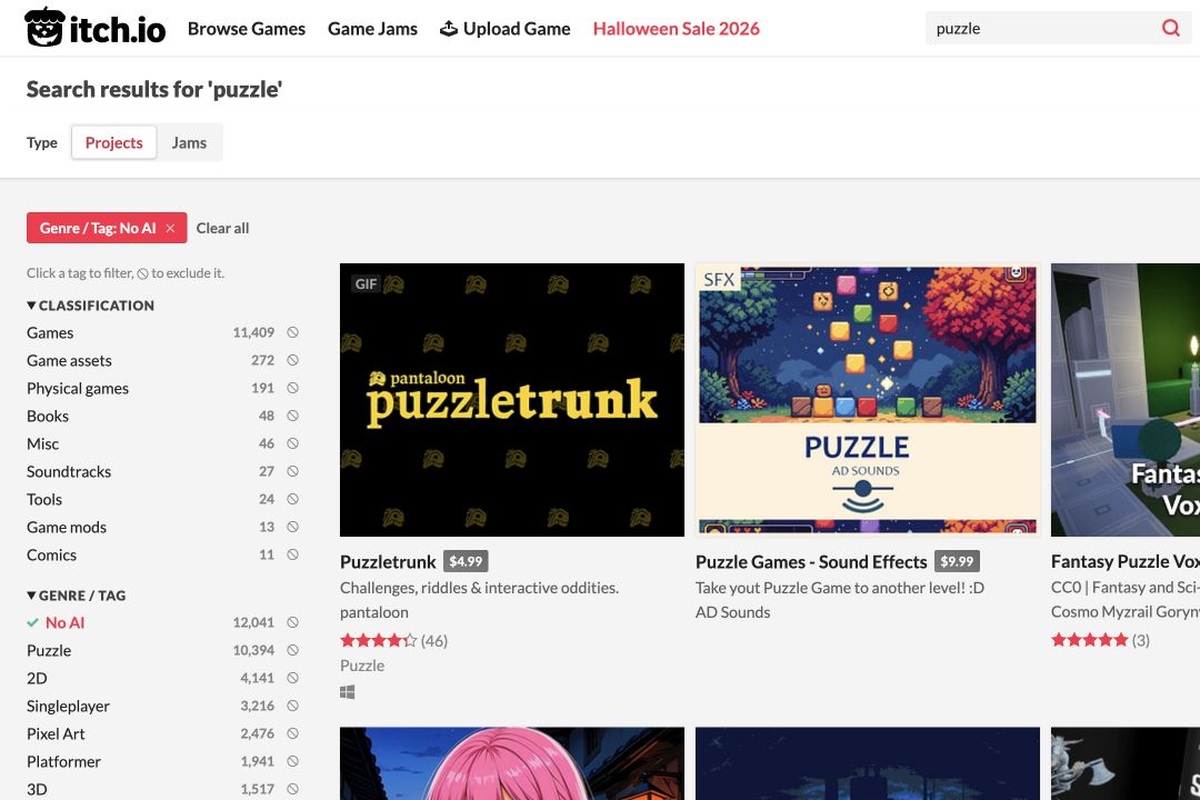
In itch.io’s search results, players can choose No AI from the genre and tag filters. The store also shows a separate AI section with options for assisted projects and individual disclosures for code, graphics, text and audio. We verified that selecting No AI narrows the query and displays an active filter above the results. Filtered search
The No AI tag is applied when a creator explicitly says their project contains no generative AI. That means it can leave out older games and other projects whose creators have yet to complete the disclosure. The tag represents a creator’s declaration, so its value depends on people filling out the form accurately. Tagging rules
More Creators Have to Declare AI Use
Creators in the physical games, books, comics and soundtracks categories now have to complete the AI disclosure when they create or edit a page. Game asset creators already faced that requirement. The change also applies when a tabletop creator edits an existing listing, giving people looking for new modules or rulebooks more information as those pages are updated. Disclosure announcement
The platform allows AI-assisted work and asks creators to label generated material. Its quality guidelines treat mass-produced pages as spam, including projects made mainly by automated tools with little human involvement and repeated variations of essentially the same content. Traditional game systems such as enemy pathfinding and self-contained procedural generation are outside its generative AI disclosure rules. Creator guidelines
First-Time Uploaders Drove the Page Surge
We previously reported that daily game-page creation roughly doubled in two months, from around 3,000 in early August to roughly 6,000 by late October. Downloads and purchases did not double with it. itch.io has since said that its own analysis attributes the growth to first-time uploaders and that it already removes bulk uploaders from its discovery index. Upload analysis
That update leaves two separate questions for indie developers. How many people are publishing for the first time is a measure of activity on the platform. How often players find and download those projects depends in part on what shows up in search. The new filters give players more control over those results, while the removal figure leaves open how much of the recent growth involved AI-generated games.