Key Notes
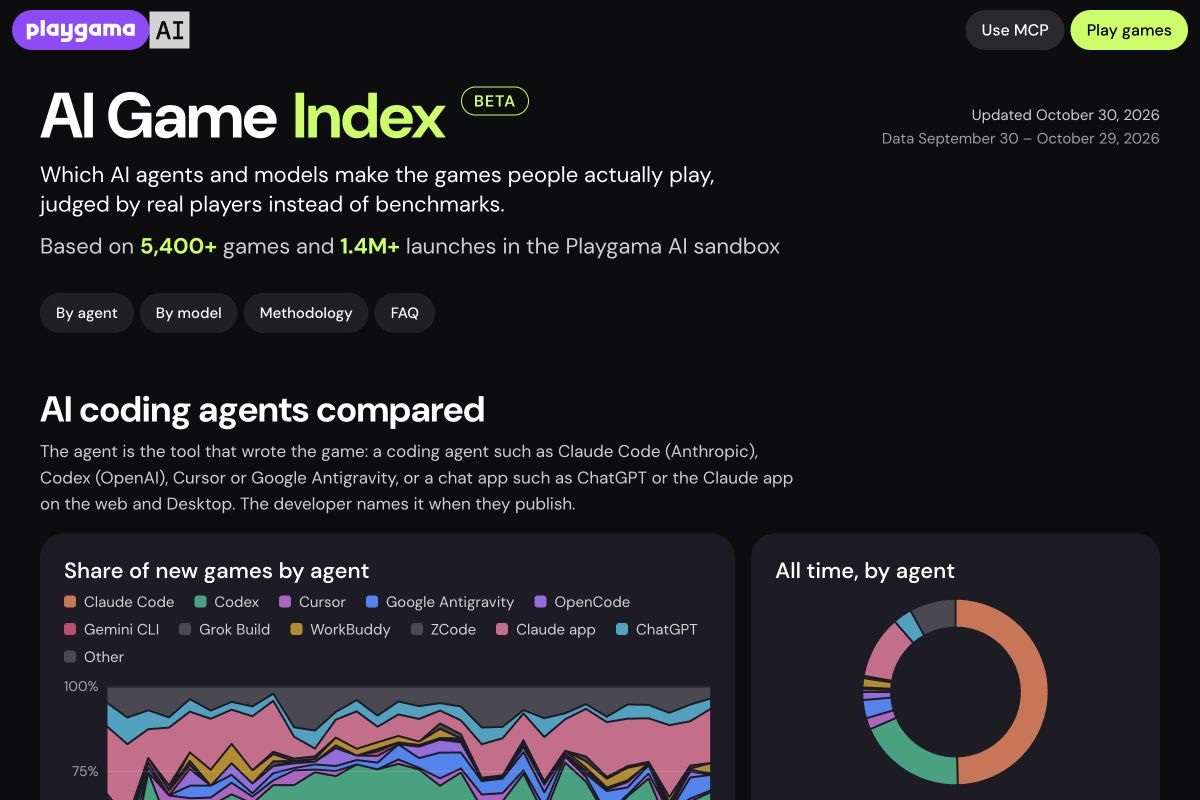
- Playgama’s AI Game Index compares coding tools and models through published browser games, tracking adoption, playtime and likes rather than assigning one overall winner.
- The October 29 snapshot listed over 5,400 games and 1.4 million launches, while engagement rankings require minimum samples of games and plays.
- Developer-supplied labels are unverified and cover only Playgama’s AI Sandbox, so the results do not establish a universal ranking of model quality.
Playgama has introduced AI Game Index, a public service comparing AI coding tools and models through the browser games developers publish with them. Instead of judging generated code alone, it tracks how long people play those games and how often they leave likes.
The beta index updates daily. Its October 29 snapshot listed more than 5,400 games and 1.4 million launches across Playgama’s AI Sandbox. Launches are not unique players, and those platform-wide totals include games without an identified agent or model.
Three Measures, Rather Than One Overall Winner
The index reports each tool’s share of newly published games, playtime and likes per 1,000 plays. Playtime starts with a game’s average session length, counting sessions of at least 30 seconds. It then compares the median game within each tool or model group, reducing the influence of a single unusually successful release.
Games need 20 plays to enter engagement rankings, and a tool or model needs 15 qualifying games. Publication share measures adoption within the Sandbox; the engagement measures address what happens after release. A tool used for many projects therefore need not lead on either playtime or likes.
For developers, that distinction is useful. A popular coding assistant might be widely chosen because creators already know it, while a less common tool could be associated with games that hold attention longer. Neither observation, by itself, shows what caused the difference.
Tools and Models Are Separate Comparisons
Creators identify both their coding tool and underlying model when publishing. Playgama separates those labels because one tool can use different models. The labels are self-reported, unverified and do not specify model versions.
That makes this an observational comparison of finished projects, rather than a controlled contest using identical instructions. A developer’s design, assets, revisions and experience can all affect the result. Longer sessions may be valuable for one genre, while a short puzzle designed for a quick break may succeed on different terms.
Traffic also matters. Projects promoted to an existing community may attract a different audience from games discovered through a portal. A median limits the effect of one hit, but it does not make those audiences or development conditions identical. The index is most useful as a source of questions to investigate, rather than proof that switching models will improve a particular game.
A Feedback Loop for Browser-Game Creators
The index sits alongside Playgama’s existing publishing tools. The company connects game uploads, Sandbox distribution and analytics through its Bridge SDK and MCP integration, which lets compatible coding agents work with external services.
Playgama says developers can add custom events to record where players get stuck or which upgrades they choose. An agent can use that information to suggest changes and upload a revised build. Those project-level observations can be more actionable than an aggregate ranking: a studio can investigate a difficult tutorial or broken progression instead of guessing why players leave.
Publishing to the Sandbox is also separate from entering Playgama’s main catalogue. Its MCP page describes a route to a public playable link, with the Bridge SDK required for submissions. The index should not be read as a ranking of every game distributed through Playgama or every AI-assisted game released elsewhere.
We previously covered Google’s Playground and the planned Unity Spark integration, which focus on building and sharing browser-playable projects. Playgama’s index addresses the next question: once a game is published, do people want to keep playing it?